
Singapore and China: Which Country is Better in 2026?
Singapore and China
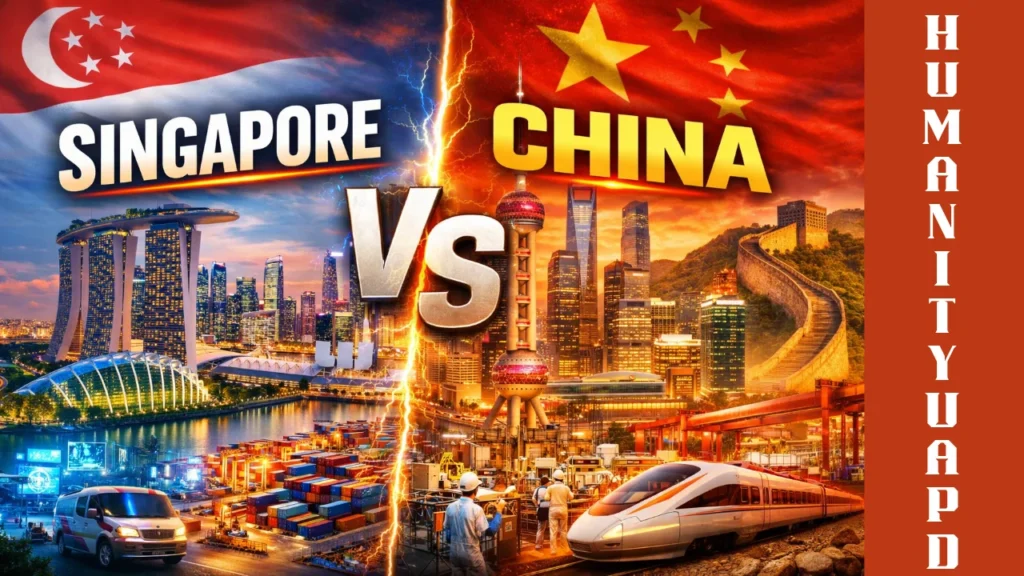
Singapore and China represent two distinct yet influential entities in the global landscape, each characterized by its unique geography, economic strategies, and cultural heritage. Situated in Southeast Asia, Singapore is a city-state known for its strategic geographical position as a global shipping hub. With an area of just 728.6 square kilometers, Singapore is home to approximately 5.7 million residents, fostering a diverse culture that blends Asian and Western influences. The political system of Singapore is a parliamentary republic, exhibiting a stable governance model that has enabled rapid economic growth and infrastructural development.
In contrast, China, the world’s most populous nation, boasts a landmass of approximately 9.6 million square kilometers, housing nearly 1.4 billion inhabitants. It exhibits a vast array of geographical features ranging from mountains to rivers and plains, which contribute to the country’s immense cultural and historical richness. China operates under a single-party socialist republic framework, where the Communist Party of China (CPC) maintains a significant role in shaping policy and governance. This political structure has allowed for sweeping economic reforms, positioning China as the second-largest economy globally.
The economies of Singapore and China have evolved significantly over the years. Singapore’s economy heavily relies on finance, manufacturing, and technology, establishing itself as a global center for commerce and innovation. Meanwhile, China’s economy, with its emphasis on manufacturing and export, has progressed at an astounding pace through state-driven efforts and market reforms, making it a vital player in international trade. Understanding the foundational elements of these two regions is crucial for any analysis of their differing approaches to innovation, economic strategy, and cultural growth.
👉 Table of Contents 👇
Historical Background and Development
The historical trajectories of Singapore and China reveal profound contrasts that have significantly influenced their current economic and political landscapes. Singapore, originally a small trading post established in 1819 by Sir Stamford Raffles, underwent a remarkable transformation throughout the 20th century. Following its establishment, the island attracted numerous merchants due to its strategic location along the Strait of Malacca.
However, the path to becoming a global financial hub was not linear; Singapore faced considerable challenges, including World War II occupation and subsequent conflicts during the post-war period. Its independence in 1965 marked a pivotal moment, leading to comprehensive reforms under the leadership of Prime Minister Lee Kuan Yew. His government’s focus on industrialization, attracting foreign investments, and fostering a skilled labor force laid the groundwork for Singapore’s rapid economic growth.
In contrast, China’s historical development has been characterized by its vast civilization, which dates back thousands of years. The transition from imperial rule to a republic in the early 20th century was turbulent, marked by political strife and social upheaval. The establishment of the People’s Republic of China in 1949 under communist leadership initiated significant economic reforms, yet it wasn’t until the late 20th century that substantial shifts occurred. Under the leadership of Deng Xiaoping, the country embraced a socialist market economy, leading to unprecedented growth and elevating it to one of the largest economies globally. The Open Door Policy marked China’s integration into the global economy, fostering international trade and investment.
Both nations have navigated their respective historical contexts to emerge as influential players on the world stage. While Singapore capitalized on its geographic advantages and strategic initiatives to redefine its economy, China’s historical depth provided a foundation for a dramatic economic transformation. The resultant economic landscapes of both countries underscore the importance of historical context in shaping modern innovations and economic strategies.
Economic Systems and Growth Models
The economic systems and growth models of Singapore and China exhibit significant differences, shaped by their unique historical, social, and political contexts. Singapore operates under a highly developed free-market economy, characterized by its openness to foreign trade and investment. This model enables the nation to attract significant foreign capital, contributing to its robust GDP growth. In contrast, China’s economic system is often described as a socialist market economy. While it has embraced market principles since the late 1970s, the state retains a substantial role in the economy, influencing key sectors through strategic planning and regulation.
Singapore has consistently recorded impressive GDP growth rates, often exceeding 4% annually in recent years, driven by high productivity levels and an emphasis on innovation. The country’s pro-business policies, efficient regulatory frameworks, and investment in education and technology have facilitated its ascent as a global trade hub. Conversely, China’s rapid economic expansion has been remarkable, with GDP growth peaking at 14% during the 2000s. The nation’s focus on manufacturing and exporting has transformed it into the world’s second-largest economy, although recent years have witnessed a gradual slowdown.
Regarding trade policies, Singapore promotes an open trade environment, signing numerous free trade agreements that enhance its competitive edge. Conversely, China has adopted a more protectionist stance in certain sectors while pursuing initiatives like the Belt and Road Initiative to expand its global trade presence. Foreign investment plays a crucial role in both economies, yet their approaches differ. Singapore’s well-established investment climate attracts multinational corporations, while China’s foreign investment strategies often come with stringent regulations aimed at fostering domestic industries.
Finally, technology and innovation serve as vital components driving economic growth in both countries. Singapore places a particular emphasis on research and development, positioning itself as a leader in technology-driven industries. China, on the other hand, has made substantial investments in technological advancements, emerging as a global leader in sectors such as telecommunications and artificial intelligence. Both nations continue to refine their economic models, demonstrating resilience and adaptability in the face of global economic challenges.

Technological Advancements and Innovation
Technological advancements in both Singapore and China have reshaped their economies and influenced global trends. Singapore, known for its strategic regional position, has become a thriving hub for technology and innovation, significantly contributing to its economic landscape. The nation has invested heavily in information technology and biotechnology, leading to various breakthroughs. Initiatives such as the Smart Nation program aim to harness technology in improving residents’ quality of life, particularly in sectors such as healthcare and urban planning. Companies like Grab and Sea Group are emblematic of Singapore’s embrace of the digital economy, innovating from e-commerce to digital transportation.
On the other hand, China has emerged as a global leader in technological innovations, significantly advancing in areas such as artificial intelligence (AI) and information and communications technology (ICT). Recent years have seen the rise of major tech firms like Alibaba and Tencent, which are not just local giants but players on the international stage. The Chinese government has also laid out ambitious plans with its “Made in China 2025” initiative, which emphasizes research and development, aiming to enhance the country’s manufacturing capabilities through technological innovations.
Investments in technology are pivotal to both countries’ futures. In Singapore, there is a concerted effort to nurture a strong research community by forging partnerships between universities, companies, and government agencies. Conversely, China’s rapid advancements in AI and biotechnology are largely driven by significant public and private investments, with the government actively promoting policies that favor innovation. As both nations continue to invest in technology, the competition and collaboration in technological advancements are likely to shape diverse industries, inevitably impacting their economic trajectories.
Education Systems and Workforce Development
The education systems in Singapore and China are often regarded as two of the most effective globally, each embodying distinct characteristics that reflect their socio-economic priorities and cultural values. In Singapore, the education policy emphasizes a comprehensive approach to develop a skilled workforce, prioritizing Science, Technology, Engineering, and Mathematics (STEM) education as a central component of the curriculum. This focus is not merely academic; it also aims to foster critical thinking and innovation, ultimately preparing students for a competitive global job market.
Conversely, China’s education system has historically prioritized rigorous academic performance, particularly in STEM fields. Recent reforms aim to reduce the intense pressure on students while expanding access to vocational training programs. The Chinese government recognizes the significance of skilled labor in driving economic growth, thus fostering a dual approach that balances academic rigor with vocational skills that are essential for industrial advancement.
Vocational training holds a special place in both nations, albeit with different methodologies. In Singapore, vocational education is integrated into the mainstream education system, offering pathways that lead directly to employment, thus aligning educational outcomes with the needs of industry. This practical application of skills ensures students are job-ready, giving them an edge in a dynamic economic landscape.
In contrast, China’s vocational education system has gained traction, particularly in response to the rapid industrialization that necessitates a skilled workforce. There has been a significant investment in the infrastructure to support vocational training, including partnerships between educational institutions and industries. This collaboration enables practical learning experiences, which are crucial in developing a workforce capable of meeting contemporary challenges.
Both Singapore and China also recognize the importance of international collaboration in education. Global partnerships and exchange programs facilitate knowledge sharing and innovation, further enhancing workforce development. These cooperative efforts allow both nations not only to grow their local economies but also to contribute to global advancements in technology and education reform.
Cultural Influences and Dynamics
The cultural landscapes of Singapore and China are both unique and intricate, shaped by diverse historical influences and a multitude of ethnic backgrounds. Singapore, a global city-state, is often lauded for its harmonious multicultural society, where various ethnic groups, including Chinese, Malay, Indian, and others, coexist. This cultural dynamism not only enhances societal cohesion but also influences business practices and interactions within the workforce. The emphasis on mutual respect and understanding among different cultures in Singapore has fostered an environment conducive to innovation and economic growth.
Conversely, China’s culture is deeply rooted in thousands of years of history, characterized by strong Confucian values that emphasize hierarchy, collectivism, and respect for authority. The influence of traditional Chinese culture is evident in the way businesses operate, which often involves lengthy relationship-building sessions and an emphasis on face-saving within the context of interactions. As globalization permeates every aspect of life in China, the blend of traditional cultural practices and modern entrepreneurial spirit has led to a unique dynamic that is propelling the nation into the forefront of global innovation.
In both regions, cultural influences shape consumer behavior and market trends. In Singapore, the multicultural environment encourages adaptability and innovation in business strategies to cater to the diverse preferences of its population. In contrast, China’s rapid urbanization and economic transformation are reshaping cultural norms as well, influencing consumer behavior towards a more individualistic approach in urban areas, while rural regions may still align closer with traditional values.
The intersection of culture with economic activities and governance is thus strikingly apparent in both Singapore and China. While the former embraces diversity as a strategic advantage, the latter navigates through its rich heritage to forge a modern economic landscape. As these countries continue to evolve, observing the interplay of cultural influences will provide valuable insights into their respective paths to sustainable development.
Environmental Policies and Sustainability Efforts
The environmental policies and sustainability efforts in both Singapore and China reflect their distinct approaches to tackling ecological challenges and minimizing climate change impacts. Singapore, a small island city-state, has implemented comprehensive strategies that focus on the integration of sustainable urban planning, green technology, and public engagement. The government has prioritized creating smart cities, emphasizing the utilization of technology to enhance the urban environment. This includes initiatives such as the Smart Nation Program, which leverages data-driven solutions to improve ridership on public transport, reduce energy consumption, and promote responsible recycling.
Additionally, Singapore’s commitment to sustainability is showcased through its Green Plan 2030, which sets ambitious targets for reducing carbon emissions, conserving energy, and increasing green spaces within urban environments. This plan underscores the importance of achieving a low-carbon economy while enhancing ecological conservation efforts, including initiatives to protect local habitats and increase biodiversity. The adoption of the Building and Construction Authority’s (BCA) Green Mark scheme incentivizes the construction of energy-efficient buildings, showcasing Singapore’s commitment to leveraging technology for environmental benefits.
In contrast, China, facing the challenges of rapid urbanization and industrialization, has embarked on an expansive journey towards sustainability through robust renewable energy projects and climate change policies. As the world’s largest emitter of greenhouse gases, China has recognized the necessity of transitioning to cleaner energy sources, resulting in substantial investments in solar and wind energy that have positioned the country as a global leader in renewable energy capacity. Initiatives like the “Silk Road Economic Belt” and the “Green Belt and Road Initiative” promote environmentally friendly investments abroad, aiming to foster sustainable development across participating nations.
China’s environmental policies also encompass rigorous regulations aimed at reducing pollution levels and mandating environmental assessments for new projects. These shifts reflect a broader recognition of the need for sustainable economic growth, balancing industrial development with ecological preservation. As both nations enhance their efforts in environmental policy, their approaches provide valuable insights into addressing global sustainability challenges.

Challenges Faced by Singapore and China
Singapore and China, despite their multiple successes and innovations, confront significant challenges that could affect their future development. One major issue is economic disparity. In Singapore, the wealth gap has been widening, with a rise in the number of low-income households. This, coupled with a high cost of living, raises concerns over social stability and inclusive growth. Meanwhile, in China, the transition from a manufacturing-driven economy to a more service-oriented model has left some regions behind, exacerbating income inequality.
Another pressing challenge for both nations is their aging populations. Singapore is one of the fastest-aging countries globally, with predictions indicating that by 2030, nearly one-fifth of its population will be over 65 years old. This demographic shift could place immense pressure on healthcare systems and social services. In China, the aging population poses similar risks, compounded by the legacy of the one-child policy, which has resulted in a shrinking labor force that may hinder economic growth.
Additionally, environmental degradation constitutes a critical challenge for both Singapore and China. Rapid industrialization and urbanization have led to significant air and water pollution in China, which undermines public health and agricultural productivity. Singapore, despite its robust environmental policies, faces issues related to land scarcity and rising sea levels due to climate change, which threatens its coastal infrastructure and livelihoods.
Lastly, geopolitical tensions represent an overarching challenge impacting both nations. Singapore’s strategic position often puts it at the crossroads of US-China relations, leading to a delicate balancing act in foreign policy. For China, ongoing territorial disputes and trade relations with other countries can lead to uncertainties that may affect its economic outlook. These challenges necessitate strategic planning and international cooperation to ensure sustained growth and stability for both Singapore and China.
FAQs: Common Questions about Singapore and China
Singapore and China are two fascinating countries, often compared due to their rapid development and unique cultural identities. Here, we address some frequently asked questions to enhance your understanding of these nations.
What are the main cultural differences between Singapore and China?
While both countries have Chinese roots, Singapore is a melting pot of cultures. It features a blend of Chinese, Malay, Indian, and other cultures, which is reflected in its festivals, food, and languages. In contrast, China has a more homogeneous culture, with a strong emphasis on traditional values, Confucianism, and linguistic unity, primarily driven by the Mandarin language.
How do Singapore and China compare economically?
Singapore’s economy is characterized by its status as a global financial hub with a robust services sector, including finance, shipping, and tourism. Its strategic location enhances its attractiveness for foreign investments. On the other hand, China has the world’s second-largest economy, driven by manufacturing and technology. Its economy is transitioning from an export-driven model to a more consumption-based one, impacting its economic relations with Singapore.
What are some travel tips for visiting Singapore and China?
When visiting Singapore, be prepared for a clean and efficient urban environment, and consider using public transport for ease of travel. In contrast, China presents a diverse travel experience; knowing basic Mandarin phrases can be advantageous, especially in less touristy areas. Be aware of regional customs and etiquette, as these can vary significantly across China.
How do the educational systems in Singapore and China differ?
Singapore’s education system emphasizes critical thinking and creativity alongside a strong focus on mathematics and science. China, with its rigorous exam-oriented approach, prioritizes discipline and memorization. Both systems produce high-achieving students, but they utilize different methodologies to reach their educational goals.
This section can assist in demystifying some common queries regarding Singapore and China. Each country has its unique attributes that make it worth exploring further, contributing to a richer understanding of both nations.

Share this:

Discover more from HUMANITYUAPD
Subscribe to get the latest posts sent to your email.