
Mesopotamia and Persia: Ultimate History Breakdown (2026)
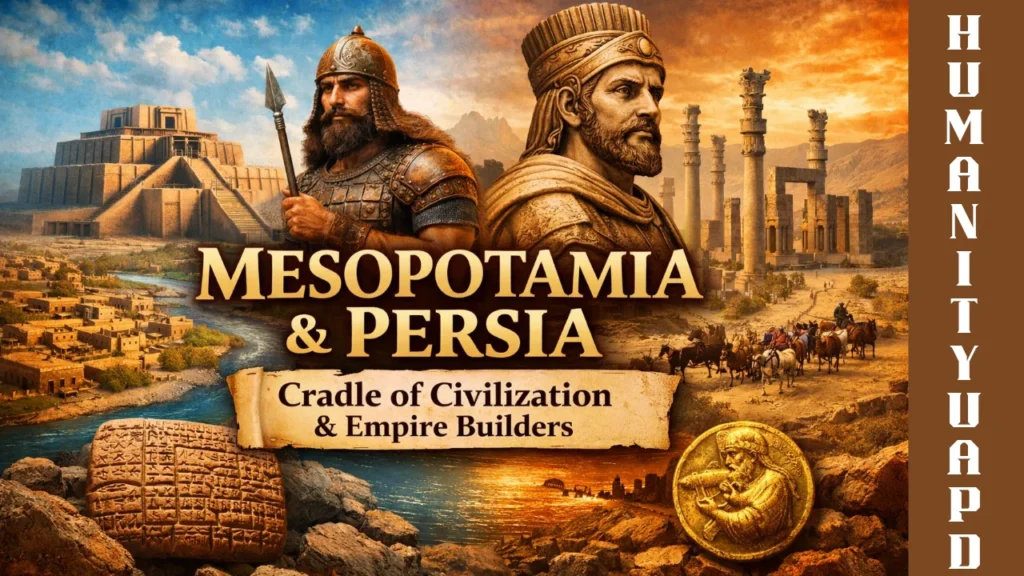
Mesopotamia and Persia
Mesopotamia, often referred to as the “Cradle of Civilization,” is located between the Tigris and Euphrates rivers, primarily in present-day Iraq. This ancient region is notable for being one of the first places where complex urban centers emerged, marking the beginning of significant advancements in human society around 3500 BCE. The key civilizations that thrived in Mesopotamia include the Sumerians, Akkadians, Babylonians, and Assyrians. Each of these societies made substantial contributions to science, mathematics, and writing, with the invention of cuneiform, one of the earliest forms of writing.
Persia, corresponding largely to modern-day Iran, evolved as a significant empire from the 6th century BCE, characterized by its extensive territorial expansion and sophisticated administration under leaders such as Cyrus the Great and Darius I. The Persian Empire became renowned for its innovations in infrastructure, including the construction of roads and the establishment of an efficient postal system. These advancements not only facilitated trade and communication but also enabled a level of administrative organization that influenced subsequent empires.
Both Mesopotamia and Persia played pivotal roles in shaping human history, particularly in scientific domains. They laid the groundwork for mathematics through concepts such as the sexagesimal system, which is still fundamental in measuring time in hours and minutes. Furthermore, the advancements in astronomy and medicine in these regions provided the basis for future studies that would extend throughout the ages.
The enduring legacy of these ancient civilizations continues to resonate today, illuminating the profound impact that Mesopotamia and Persia have had on science, culture, and governance across the globe. Understanding their contributions offers critical insights into the development of human knowledge and society.
👉 Table of Contents 👇
The Geography and Climate of Mesopotamia and Persia
Mesopotamia, often referred to as the “Cradle of Civilization,” is characterized by its rich geographic features that profoundly influenced its development. Nestled between the Tigris and Euphrates rivers, this region offered fertile land conducive to agriculture, which was pivotal for the sustenance of its populace. The annual flooding of these rivers deposited nutrient-rich silt on the plains, creating a landscape ideal for cultivating crops such as barley, wheat, and legumes. The reliance on a steady water supply facilitated the growth of complex societies that advanced into urban centers.
In contrast, ancient Persia, encompassing present-day Iran, is marked by its diverse topography that ranges from rugged mountains to vast deserts and plateaus. The Zagros and Alborz mountain ranges dominate the western part, serving as natural barriers that influenced settlement patterns and defense strategies. The expansive deserts in the central and eastern regions posed challenges but also allowed for the development of unique trade routes such as the Silk Road, enhancing intercultural exchange. The natural resources found in these terrains—such as minerals, precious stones, and fertile highlands—played a crucial role in the economic robustness of Persian civilizations.
The climates of Mesopotamia and Persia also varied significantly, dictating agricultural practices and lifestyle. Mesopotamia generally experienced a hot, arid climate, with seasonal rainfall influencing farming schedules. In contrast, the northern regions of Persia enjoyed a cooler climate with ample rainfall. Despite these differences, both regions adapted their agricultural methods accordingly, implementing innovative irrigation systems that optimized water distribution and enhanced crop yields. The intricate relationship between geography, climate, and human activity in Mesopotamia and Persia not only reshaped their societies but also laid foundational principles for future civilizations.
The Rise and Fall of Civilizations in Mesopotamia
Mesopotamia, often referred to as the “Cradle of Civilization,” was home to several significant cultures over thousands of years. Among these, the Sumerians, Akkadians, Babylonians, and Assyrians stand out for their remarkable contributions to humanity. The rise of the Sumerians in the 4th millennium BCE marked the beginning of organized urban society. They established city-states such as Ur, Eridu, and Uruk, characterized by sophisticated governance, written language, and advancements in agriculture and trade.
The Akkadian Empire followed the Sumerians, with Sargon of Akkad uniting various city-states into one of the world’s first empires around 2334 BCE. This era saw the introduction of Akkadian as a language, which elevated the region’s literary culture. The economy flourished due to trade across vast territories, ranging from the Mediterranean to the Indus Valley, enabling cultural exchanges unparalleled at the time.
However, the rise of these civilizations was often shadowed by their decline. The Babylonians, famous for the Code of Hammurabi, saw their power surge in the 18th century BCE, only to be weakened by internal strife and the threat of neighboring peoples. The Assyrians emerged next, known for their military prowess and expansive empire, which eventually reached its zenith in the 7th century BCE. Unfortunately, their aggression led to widespread warfare, contributing to their rapid decline as they faced retaliation from coalitions of other states.
Throughout these transitions, social structures evolved, moving from theocratic leadership to more imperial governance. Economically, agriculture remained the foundation, supported by innovations such as irrigation systems that enhanced productivity. The crumbling of these mighty civilizations serves as a reminder of the complexities inherent in societal rise and decline, influencing the historical trajectory of the region that shaped global civilization.

The Persian Empire: A Historical Overview
The Persian Empire, one of the most significant empires in ancient history, emerged around the 6th century BCE under the leadership of Cyrus the Great. His reign marked the beginning of a vast empire that would eventually encompass significant portions of the ancient world, stretching from the Indus Valley in the east to the Mediterranean Sea in the west. Cyrus’s innovative approach to governance, which included respect for the customs and religions of the peoples he conquered, served to stabilize and secure the vast territories of his empire.
Following Cyrus, his successors, notably Darius the Great, expanded the empire even further and implemented a series of administrative reforms that enhanced its efficiency. Darius is credited with reorganizing the empire into satrapies, or provinces, each governed by a satrap. This structure allowed for better taxation, local governance, and military organization, helping to maintain control over the diverse and expansive regions of the Persian Empire.
Military prowess was a cornerstone of the Persian Empire’s success. The Achaemenid army, well-trained and strategically commanded, engaged in numerous military campaigns that resulted in significant territorial expansion. Darius’s campaigns against Greece would later lead to famous battles, such as those at Marathon and Thermopylae, although the empire ultimately faced challenges from this formidable adversary.
Culturally, the Persian Empire was remarkably vibrant. It was a melting pot where various cultures meshed, leading to significant advancements in art, architecture, and science. Notable achievements include the construction of monumental architecture, such as Persepolis, and the development of a sophisticated administrative system that promoted commerce and communication across vast distances. Through these achievements, the Persian Empire not only shaped its own historical narrative but also influenced subsequent civilizations in profound ways.
Scientific and Technological Advances in Mesopotamia and Persia
The civilizations of Mesopotamia and Persia were at the forefront of scientific and technological innovation, leaving a lasting legacy that continues to influence modern society. One of the remarkable advancements made during this period was in agriculture, where the development of irrigation systems allowed for large-scale farming in otherwise arid regions. Techniques such as the use of canals and levees enabled farmers to harness the fertile soil of the river valleys, thus increasing crop yields and supporting growing populations. The impact of these innovations can still be seen today in modern agricultural practices that emphasize efficient water management.
Mathematics was another field where significant progress was made. The Sumerians conceived of a base-60 number system which influenced our current measurement of time and angles. This early mathematical framework laid the groundwork for more advanced calculations and has permeated into various scientific disciplines. The use of geometric principles in land surveying and construction is a direct legacy of these early mathematical achievements, echoing in contemporary engineering and architecture.
Astronomy flourished under the auspices of both Mesopotamian and Persian scholars, who meticulously recorded celestial events and developed calendars based on lunar and solar cycles. Their observations of planetary movements were sophisticated for their time, contributing to the understanding of the cosmos and influencing later astronomical studies in diverse cultures. Furthermore, the technological advancements in engineering led to monumental infrastructures, such as the famed ziggurats of Mesopotamia and the impressive palaces of Persia. These feats of engineering not only displayed the ingenuity of their creators but also laid the foundational principles for modern civil engineering.
Overall, the scientific and technological advances exhibited by Mesopotamia and Persia were pivotal in shaping various sectors that are integral to contemporary life, illustrating the profound impact of these ancient civilizations on future generations.
Art and Architecture of Mesopotamia and Persia
The artistic expressions and architectural achievements of Mesopotamia and Persia showcase the richness of their respective cultures, reflecting both functionality and intricate aesthetics. Mesopotamia, often referred to as the “Cradle of Civilization,” is renowned for its ziggurats—massive stepped structures that served as temples for worship. These ziggurats, such as the Great Ziggurat of Ur, exemplify the engineering prowess of ancient Sumerians, as well as their religious devotion, towering above the landscape as a bridge between earth and the divine realm.
Constructed with sun-baked bricks, these monuments featured a tiered design that was both symbolic and practical, allowing priests to ascend closer to the heavens. Alongside ziggurats, Mesopotamian art also flourished through reliefs and cylinder seals often depicting everyday life, deities, and mythological creatures, which served both decorative and administrative purposes.
Conversely, Persian architecture reached new heights of grandeur with structures that epitomized imperial power and cultural sophistication. The palaces in Persepolis, built during the reign of the Achaemenid Empire, are prime examples of sophisticated Persian architecture characterized by their monumental columns, exquisite carvings, and sprawling complexes. These palatial structures were not only sites of governance but also represented the wealth and pluralism of the empire, drawing inspiration from various cultures absorbed through conquests. The art found within these palaces features intricate bas-reliefs and motifs that celebrate the diversity of the empire, often depicting scenes of tribute and ceremonial gatherings.
Both Mesopotamian and Persian artistic expressions reveal a deep connection to their societies’ values, religions, and political structures. Understanding the artifacts, structures, and the artistic styles prominent in these regions provides insightful perspectives into the lives of their inhabitants, marking their significant contributions to the overall tapestry of human history.
Trade and Economy in Mesopotamia and Persia
The economic landscape of ancient Mesopotamia and Persia was rich and diverse, characterized by intricate trade networks that facilitated the exchange of goods across vast territories. These systems not only strengthened local economies but also enabled cultural interactions that influenced the regions profoundly. As one of the world’s earliest centers of civilization, Mesopotamia developed a structured economy, which included both barter and the introduction of currency. By around 3000 BCE, the use of silver as a standardized medium of exchange emerged, making trade transactions more efficient and regulated.
Key goods traded in Mesopotamia included barley, textiles, and metalwork, with trade routes extending from the Mediterranean coast to the Indian subcontinent. The availability of rich natural resources, such as copper and tin, allowed for the production of valuable items like tools and weapons, which were often traded with other civilizations. Persian trade, particularly during the Achaemenid Empire, expanded even further, encompassing lands from the Balkans to the Indus River, which facilitated the exchange of not only physical goods but also ideas and technologies.
The Silk Road is another significant aspect of the trade in Persia, acting as a vital artery that connected East and West. It played a crucial role in the dissemination of cultural and economic practices. Through these networks, Mesopotamia and Persia became melting pots of various cultures, fostering multicultural exchange. Moreover, the economic activities during these periods laid the groundwork for future trading concepts, including market systems and negotiation methods that are still relevant today. The legacy of these ancient trade and economic practices continues to influence global trade dynamics, illustrating the historical significance of Mesopotamia and Persia in shaping world economics.

Cultural Legacy of Mesopotamia and Persia
The cultural contributions stemming from the ancient civilizations of Mesopotamia and Persia are deemed invaluable as they have significantly influenced various aspects of modern society. One of the most profound legacies of these civilizations is the development of writing systems, notably cuneiform in Mesopotamia and Old Persian in the Persian Empire. Cuneiform, a script developed around 3200 BCE, allowed for the documentation of transactions, legal codes, and literary works, thus facilitating the preservation and dissemination of knowledge. This invention marked a pivotal transformation in human communication, laying the groundwork for the record-keeping and information-sharing practices we see today.
Additionally, the vast body of literature that emerged from these early societies continues to resonate through the ages. Epic tales, such as the “Epic of Gilgamesh,” not only offer insight into the values and beliefs of ancient peoples but also serve as foundational texts that influenced literary traditions across the globe. The themes of friendship, mortality, and the quest for wisdom present in such epics have found their echo in the works of later writers, establishing a narrative framework that has endured throughout history.
Furthermore, philosophical thoughts originating from these two regions contributed significantly to the intellectual landscape of subsequent civilizations. The inquiries posed by ancient Mesopotamian and Persian thinkers regarding the nature of existence, ethics, and governance have shaped the philosophical discourses that underpin modern sociology and political theory. This intellectual legacy fosters a continuity of ideas that bridges cultures and epochs, illustrating how the reflections of ancient minds continue to influence contemporary thought.
Frequently Asked Questions (FAQs)
Mesopotamia and Persia are two of the earliest civilizations in human history, and they often raise queries regarding their distinct societal structures, languages, and historical impacts. Below are some common questions and their answers, aimed at providing a clearer understanding of these ancient cultures.
What were the major societal structures in Mesopotamia and Persia?
Mesopotamia’s society was organized into city-states, each governed by its own ruler. These city-states, such as Uruk and Babylon, featured class hierarchies with priests, nobles, and laborers. In contrast, Persia was characterized by a centralized monarchy under leaders like Cyrus the Great and later Darius I, who implemented administrative reforms, creating a vast, multi-ethnic empire.
What languages were spoken in Mesopotamia and Persia?
The principal languages of Mesopotamia included Sumerian and Akkadian, utilized in various cuneiform inscriptions. Meanwhile, the Persian Empire predominantly used Old Persian for official purposes, alongside Elamite and Akkadian in certain regions. Over time, Middle Persian emerged as the primary language during the Sassanid period.
What lasting impacts did these civilizations have on the world?
Both civilizations greatly contributed to human development. Mesopotamia is credited with the invention of writing, the wheel, and significant advancements in mathematics and astronomy. Persia, known for its vast empire, fostered trade and cultural exchanges across regions, influencing later societies in governance, architecture, and art.
How do Mesopotamia and Persia compare?
While Mesopotamia primarily consisted of independent city-states and tribal governments, Persia emerged as a centralized empire. Mesopotamian culture laid the intellectual groundwork for later civilizations, including Persia, which built upon these innovations. Both civilizations, though distinct, had a profound influence on the course of history.

Share this:

Discover more from HUMANITYUAPD
Subscribe to get the latest posts sent to your email.